Clothing Pricing Calculator for small-batch brands
Use this free clothing pricing calculator to build your true cost per piece, then see your margin, markup, profit on the whole run and how many pieces you need to sell to break even. VAT is handled for the UK, EU and Australia.
The figures filled in are examples to show how the tool works, not Fabrickly prices. Replace them with your own quote.
–
| Margin | Markup | Ex VAT | Incl. VAT | Profit |
|---|
Gross figures only. They leave out marketing, fulfilment, payment fees and returns. Not financial or tax advice.
How to use the clothing pricing calculator
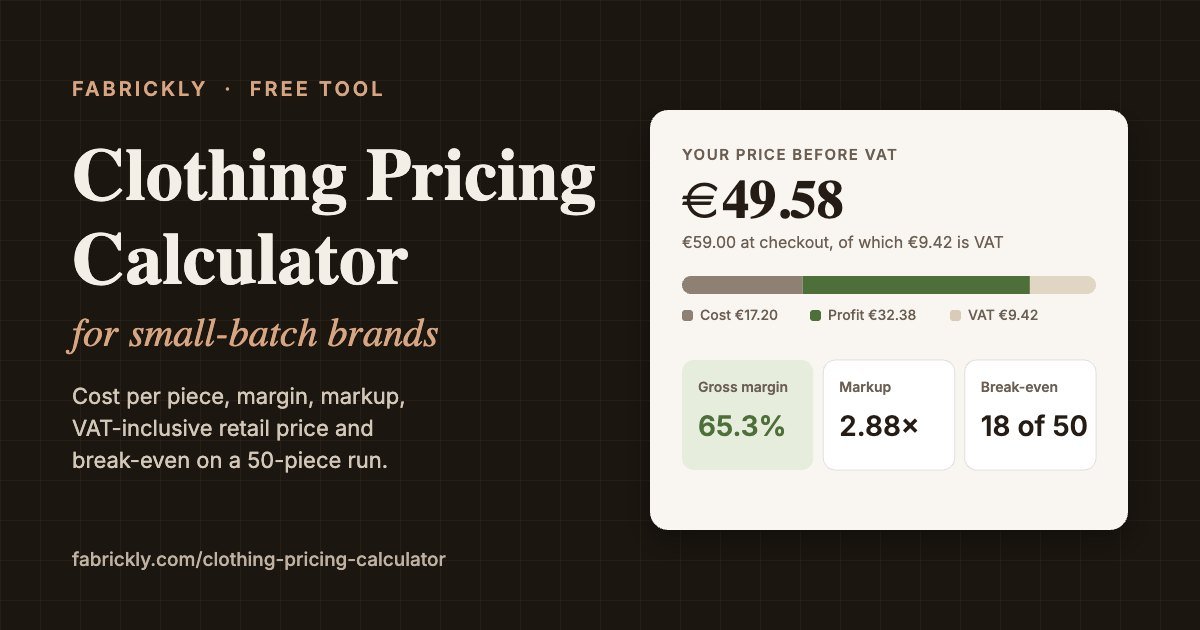
Price is where cost, customers and positioning meet. The clothing pricing calculator above does the arithmetic, so your job is to make four decisions. First, get the inputs right. Then check the result against your market.
- Find your true cost per piece. Start with the factory price, then add freight, import duty, labels and packaging. Spread one-off costs such as the tech pack and samples across the run. A €300 sample bill on 50 pieces adds €6 to every piece.
- Decide where you will sell. Selling only on your own site gives you the full margin. However, if you plan to sell to shops, your retail price also has to leave room for their margin.
- Pick a target margin. Many direct-to-consumer clothing brands aim for a gross margin of 60–75%, because advertising, shipping, payment fees and returns still have to come out of it.
- Check it against the market. Compare with three or four brands your customer already buys from. If your price is far above them, the story, fabric or fit has to justify it. On the other hand, if it is far below, you may be leaving money behind.
Margin and markup are not the same
Markup compares your price with your cost. In contrast, margin compares your profit with your price. Most pricing mistakes come from mixing them up. For example, adding 60% to the cost does not give a 60% margin. Instead, it gives a 37.5% margin.
| Markup | Margin | Cost €20 → price ex VAT |
|---|---|---|
| 2× | 50% | €40.00 |
| 2.5× | 60% | €50.00 |
| 3× | 66.7% | €60.00 |
| 3.5× | 71.4% | €70.00 |
| 4× | 75% | €80.00 |
Margins are always worked out on the price before VAT, because VAT is collected for the tax authority and is not part of your revenue. You can check current rates on GOV.UK for the UK and on the EU's Your Europe VAT page.
What belongs in your cost per piece
- Manufacturing price: fabric, cutting, sewing and finishing. With a full-package manufacturer, all of this is in one price.
- Decoration: printing, embroidery or washes, if quoted separately.
- Trims and branding: neck labels, care labels, hang tags, polybags and boxes.
- Freight, duty and customs: the cost of getting goods to your warehouse. Under DDP terms these are included in the quote.
- One-off development costs: the tech pack, samples and size grading, divided by the number of pieces.
Leave out costs that come after the goods arrive, such as ads, fulfilment and payment fees. Instead, treat those as overheads, because your gross profit has to cover them.
Using the pricing calculator for a small clothing run
A first run of 50 pieces usually costs more per piece than a run of 500. This is because one-off costs are spread over fewer pieces, and setup work is the same whatever the quantity. On the other hand, far less cash is tied up in stock you have not sold yet.
The break-even figure in the calculator shows how many pieces you need to sell to get back what you spent on the whole run. After that, everything you sell is gross profit. As a result, that money can fund the reorder, ideally of the colours and sizes that sold first.
Fabrickly makes from 50 pieces per style, with mixed sizes in that quantity. See how a low MOQ run works.
Clothing pricing calculator: common questions
How do I work out the retail price for my clothing?
Divide your true cost per piece by one minus your target margin to get the price before VAT, then add VAT if you sell to consumers in the UK, EU or Australia. For example, a €17 cost at a 65% margin gives €48.57 before VAT, or €57.80 including German VAT at 19%. Many brands then round to a price point such as €59.
What is a good profit margin for a clothing brand?
Many direct-to-consumer brands aim for a gross margin of 60–75%. Below about 50%, however, it is hard to pay for advertising, shipping, payment fees and returns. The right figure depends on your channels and your costs per order.
What is the difference between margin and markup?
Markup is price divided by cost, while margin is profit divided by price. A 3× markup equals a 66.7% margin, and a 4× markup equals 75%. Use the price before VAT for both.
Should my retail price include VAT?
Yes, when you sell to consumers in the UK, EU or Australia, because prices shown to shoppers must include VAT or GST. The calculator removes the VAT before working out your margin, since that money goes to the tax authority. In the US, prices are shown before sales tax, so choose "No VAT in price".
How do I price clothing for wholesale?
Shops usually expect to roughly double their buying price before VAT, often called keystone pricing. So your wholesale price is about half your retail price before VAT. Check that this still leaves you a healthy margin. If it doesn't, raise the retail price or lower the cost before you pitch to stockists.
Why does a small run cost more per piece?
Pattern work, cutting setup, samples and the tech pack cost the same whether you make 50 pieces or 500, so each piece carries a bigger share on a small run. You trade a higher unit cost for much less cash at risk.
Is the clothing pricing calculator free, and does it save my numbers?
It is free, with no sign-up. Everything runs in your browser and nothing is sent or stored. Use "Copy summary" to keep a record of a scenario.
Swap the example numbers for a real quote
Send us your sketch or tech pack and we reply within one business day with a quote for your style from 50 pieces. No tech pack yet? We make one in 7 days.